
What Franchise Restoration Operators Are Actually Up Against (And What I'm Building)
Working with restoration companies across the country, I keep hearing the same story from franchisees. It is the structure they operate inside, not the brands themselves, that is squeezing them.
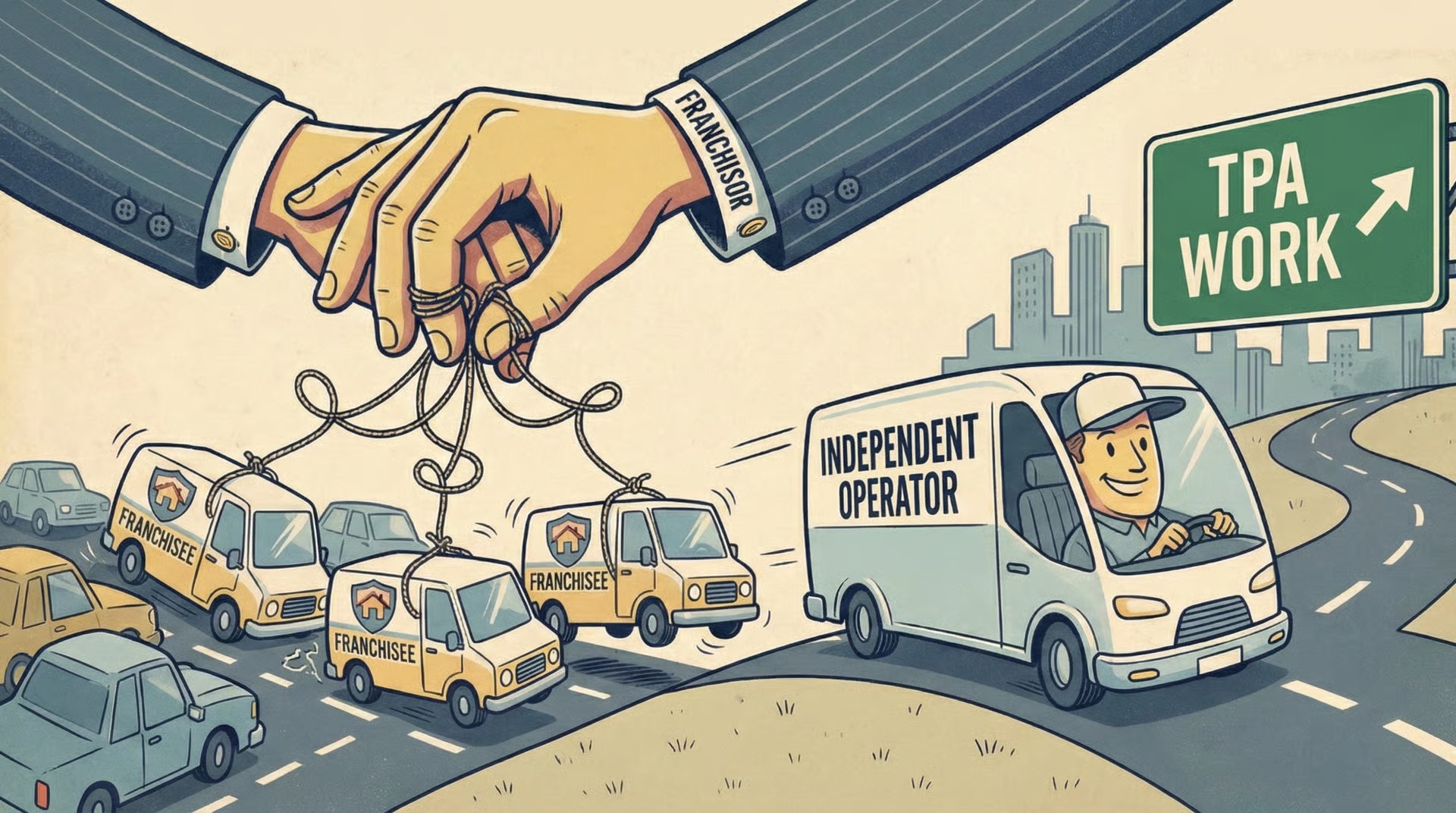
I run a restoration franchise inside one of the big national brands. I have seen the upside: name recognition, lead flow, and a playbook that independents don't always get. But I have also seen the cost of that trade from the inside. And it is not just us. Friends across the other national brands tell the same stories.
Here is the truth most franchisees do not want to admit: you are not running a restoration company. You are running an insurance company's back office operation.
And the structure is straining under it.
Franchisees across brands encounter three core problems that compound each other and create an unsustainable situation.
Problem #1: You Have No Power Over Pricing
The franchisor makes deals with carriers. In exchange for lead flow, franchisees agree to accept their pricing guidelines. Those guidelines were built around outdated workflows and standards, not today's costs, speed, or risk.
So expenses climb (labor, materials, compliance) while the ceiling on what you are allowed to bill stays tight. Revenue is boxed in. Profit gets squeezed.
But here is the worst part: even after you accept their guidelines, carriers still reject invoices. They still cut bills. And the franchisor cannot really fight for you because the carrier relationship is too valuable. The franchisee absorbs the financial consequence.
I see this every day. Field-level support can only do so much, because the carrier relationship sits above any individual franchisee in the incentive stack.
It is no wonder carriers are flocking to TPAs and newer vendor networks. The guidelines and systems we are forced to operate under were not built for today's expectations around speed, performance, and simplicity.
Problem #2: Bloat You Cannot Cut
The franchise model requires massive overhead:
- Insurance minimums (mandated)
- Staffing requirements (mandated)
- Building capacity (mandated)
- Compliance infrastructure (mandated)
- Royalties (regardless of profit)
These are not optional. You cannot run lean. You cannot adapt. You are locked into a fixed cost structure that does not scale with your actual business.
Then royalties hit. By this point, you are financing both labor and materials across dozens of open jobs while waiting on carriers to pay, and those withdrawals often land right in the middle of that gap.
Most franchisees I speak with, across the major brands, describe the same experience: survival mode. The few that have truly scaled either built parallel revenue streams, like commercial loss work, or pursued strategic M&A to restructure their debt and cost base. But even M&A is a tight rope. Mergers promise efficiency on a spreadsheet, but don't always deliver it in the field.
Problem #3: Innovation Moves at Corporate Speed
Even when everyone agrees the system is broken, you cannot change it quickly. In a franchise system, new workflows, tools, and processes move on multi-year cycles. By the time leadership approves a new way of working, the market has already moved ahead again.
So field teams are stuck solving 2026 problems with workflows designed years ago. The gap widens. Carriers get more demanding. Franchisees get more desperate.
The people closest to the work, the franchisees running jobs and battling cashflow gaps, have the least power to change anything.
That is why real innovation in this industry is not coming from the top. It is coming from operators who are building their own systems on the side and then betting their future on them.
Here Is What I Am Building Instead
Wave is my answer to this deadlock. It isn't anti-franchise; it's pro-survival.
We stopped waiting for permission. Instead of multi-year approval cycles, we test and iterate in days. Wave is what happens when you let operators, not focus groups, design the workflow: estimates are instant, billing is clean, and you stop begging to get paid.
Many franchise owners ask if Wave can make their legacy workflow faster. The honest answer? No.
You cannot make a broken system faster. You have to replace it.
Right now, we have the technology to drive a Ferrari. But the moment you enter the carrier-mandated workflow, you are forced to hitch that Ferrari to a horse. Most of the effort in this industry goes into making the horse walk faster. I think the answer is to get in the car.
The Transformation Is Coming: Just Not From the Top Down
The franchise model is not under pressure because the brands are weak. It is under pressure because the incentives are misaligned and large systems cannot move at the speed the market now demands.
All of this pressure on franchises is also the biggest opportunity independent restoration companies have ever seen. While franchisors wrestle with legacy contracts, territorial guarantees, and slow innovation cycles, independents can move in the opposite direction: faster decisions, cleaner workflows, and a direct line to the customer.
If you build for speed, transparency, and performance, you are not competing with the franchise model on its terms. You are competing on the terms the market already expects.
The future belongs to operators who refuse to wait, who push for cleaner terms, and who build systems that align incentives instead of working around them.
I have benefited from the franchise world. That is true. But I am done accepting a structure that puts this much of the risk on the people doing the work. I refuse to wait for permission.
Related Articles
How I've Made Over $3M Doing Storm Work
The playbook for running a lean storm trip that pays: where to go, when to bring the crew, and when to go home.
Nobody Knows the Number
In restoration, you don't get paid when the work is done. You get paid when the fight ends. Why we built Wave, from a family that lived it.
We Must Change Everything, Or We Die
The traditional restoration workflow is a death sentence for cashflow. Here is how we can fix it.